by Tom Evans | Apr 8, 2011 | Scribing
 So I’ve had an iPad for the best part of a year now and loads of people have asked how I use it and what I’m using it for.
Or if it’s just a bit of a toy?
Well I’ve discovered using this new type of tablet (and watch this space for the clones) ushers in a whole modus operandi.
In short, it’s brilliant – especially for writers, designers, entrepreneurs, inventors and creatives. I would struggle to go back to using a laptop.
This new way of working merits the introduction of a new word – iPadivity.
noun [n] :
1. the phenomenon of increased creativity and productivity when using an iPad – and activity while doing the same
2. the generation of new ideas using an iPad
3. profitability from generating and using iPad apps
Now I have to say everything I’ve been able to do I could do with a combination of iPhone or laptop. Some of it admittedly even with paper and pen. While the iPhone scores on portability, it lacks screen real estate and typing is slow (this whole blog incidentally was written at speed using the iPad on screen keyboard).
The laptop is just so much heavier and I have always felt a bit nerdy to get out on a commute and certainly in a coffee shop. It also takes too long to boot if you just want to do something quickly and acts as a barrier in a business meeting. The 3G enabled iPad delivers a useful synthesis of both devices which is better than both – plus I have to say it looks cool !!
This Mind Map tells the story of what I am using it for … of course generated on the iPad as were all the graphics in this blog.

The first iPadivity gain is really good use of “dead time” – those times in the day when you would have been waiting for something can now be used to process email, do a tweet or two and check out news or write a blog.
The second iPadivity benefit is being able to read, listen to or watch pretty much anything – either online, in iTunes or your own archive.
 The third iPadivity capability, and to me the most important, is being able to write stuff. Here the lightness and specific functionality of the apps comes into its own. For example, before writing each chapter of my new book, I’ve taken a hint from artist Cat Bennett and I am drawing using Brushes an image that encapsulates the concepts I am about to write about.
I am working to a master Mind Map structure for the whole book but I’ve also started mapping each chapter before eventually writing it in Pages.
This has lead me down several new avenues I simply wouldn’t have explored.
Now could I do this on the laptop or desktop – absolutely – but not when the Muse takes me – and certainly not with as much ease and FUN !!
Add to all of this, the ability to browse on a whim for research and dip into the brilliant Wikipanion app, my iPadivity is probably up 400-500% of where it was less than a year ago.
I’ve also used the iPad in several client sessions. Again, its unobtrusiveness is the key. It’s like having a paper notebook but where you can email the notes instantly. In the sessions I did last week, this included a colour-coded Mind Map of actions arising and a wireframe for an iPad app I am designing, using iMockup.

This of course points to an amazing iPadivity – the ability to encapsulate your knowledge and wisdom in an iPad app which you can share with other and generate profitability from … watch this space !!
So if you’ve got an iPad or an iPad2 or another type of tablet device, or are getting one, I’d be interested in your thoughts ….
by Tom Evans | Mar 7, 2011 | Scribing
 When I hear the word optimist, I am reminded of the phrase, “an optimist is a pessimist not in possession of all the facts.”
When I first heard this I laughed and have ‘dined out’ on it more than once when the word comes up in conversation. I confess to being a born optimist – something I inherited from my mother who always sees the bright side of everything.
On reflection though this phrase could be seen to show optimists in a dim light. It could be inferring that optimists are dreamers, Walter Mittys and that blind optimism is no more than wishful thinking.
Optimists will always see a glass as half full. Pessimists see it not just as half empty but containing a liquid which is distasteful or even poisonous. Yet sometimes optimists can become the target of those with a cynical disposition.
Well I think that such blind optimism does lead itself to being open to criticism but it has too much of a bad press. To redress this situation, it’s time that we got a bit scientific about it. So much so that I’ve coined a new term called Optimology. In fact I am really optimistic about this word as I Googled in and found nobody is using it for anything of relevance. This means that as soon as this article is published and I blog it, these viewpoints will even be on top of Google within 24 hours.
It is this type of ‘creative’ optimism that the word refers to. If you simply take an optimistic view and do not act upon it, you will have a better life than a pessimist who will simple manifest the ‘not so good’. If you take an optimistic view and act upon it, you will have a Great Life. To ensure your optimism grounds into physical reality, it is important to use the Cascade of Creativity.
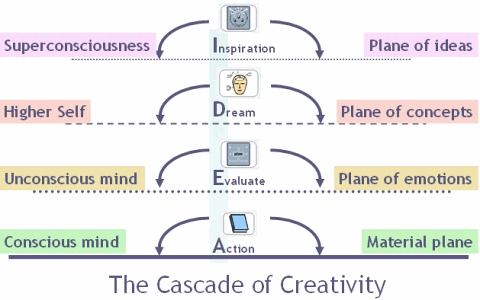
The first step towards such greatness is to back your optimism with high intent, not just wishful thinking. For example, by simply coining this term I have the seed of an Inspiration to start a new movement training professional Optimologists who teach these principles. When enough people think differently, Mother Earth tilts her axis in recognition.
The next step is to Dream where this might lead to. Imagine a world where companies employ Optimology consultants or even have one on the Executive board. For each corporate action, only the positive spins will be sought. I was trained to faciliate meetings a few years ago with a wonderful tool called Appreciative Enquiry. In it you simply discover what works well and just make it work even better. No time is spent navel-gazing or on the Blame Game. Egos aren’t supressed but harnessed and pointed in the right direction.
In Appreciative Enquiry too, the outputs of the dream phase are then managed. This is the next crucial step in the Optimology process. Before acting wildly and running off with unbridled excitment, desired outcomes are defined and tested in an Evaluation phase. So to take Optimology to the next phase, I throw the gauntlet down and ask any trainee Optimologists to get in touch. Collectively we will define a training and testing programme to see where this can go. From which we can set some goals – they will be high ones. As I know already this works, all activity will be synced to the Moon Phase.
Finally, there comes Action. My first action is to write this article and broadcast it. There will inevitably be the book to be written on the subject and all the training manuals. If this is to be, I know the right team will materialise so that this won’t just fall on my shoulders. My role is as creative spark – and CEO. Where CEO stands for Catalystic Evangelist of Optimology.
Now my ever present optimism has already created a Pretty Good Life for me. I have no desire to ‘own’ this movement or even to lead it. This is a call to action for all of an optimistic disposition out there to come together to make a change. This is no new religion and the dogmatic need not apply. The philosophy will be freely available and distributed. Revenue will generated only where Added Value is delivered.
by Tom Evans | Jan 10, 2011 | Chatting
In classical mechanics, momentum describes the product of mass times velocity. What this means is in practice is can be imagined like this.
If a golf ball is hit at 100 miles an hour and hits a steam train travelling the other way at the same speed, the golf ball which weighs somewhat less will rebound at very close to 200 miles an hour in the opposite direction. NASA makes use of this principle to slingshot space probes around planets in order to massively increase their speed. This is known as a gravitational slingshot and it uses angular momentum as its guiding principle.
So the lighter something is and the slower it moves, the lower the momentum. So how would we approach giving something which we consider having no weight a huge momentum? How do we give ideas momentum?
First we must recognise that even thoughts have some mass. They constitute the elementary fabric of the Universe from which all matter is formed. Unlike matter, thought travels faster than light which kind of makes the classical equations fall apart but, nonetheless, it means thought has both mass and velocity of a kind.
In fact, thoughts which permeate the whole of space-time only become ideas when they hit a special type of matter known as our brains. Our brains are quantum transducers that slow thoughts from the collective consciousness down and bring them into the physical plane. A transducer incidentally converts one type of energy into another – like a loudspeaker that converts electrical signals into sound waves or a microphone that works the other way around.
Once the raw thought-form is transmuted into an idea, the conversion is not complete. If we do nothing with an idea, it will float back into the mind-pool to be picked up by another brain. Anyone who has had a bright idea and done nothing with it only to see someone else coming out with their invention can tell you this.
The process of grounding ideas can be neatly explained by this model.
The thought comes to us from the Superconsciousness from the Plane of Ideas. We then dream what we can do with it interacting with our Higher Self on the Plane of Concepts – quite often this is in dream time or meditation. If we get excited by these dreams, we bring them down via our unconscious mind into the Plane of Emotions. Our gut tells us it’s a good bet and our heart falls in love with it. In this way, we pin our emotions on the idea to back it. We feel it in our water.
Finally, we bring it into our full conscious awareness the Material Plane by making a prototype. If it’s a physical product, this might be a space model. For software, you might make a wireframe walkthrough. For a service, you might seek a case study with a guinea pig client.
Incidentally, when all this happens at once, we call it a Light Bulb Moment.
Irrespective of your route what has happened is the nearly weightless idea has been given mass. For the next trick, for it to have momentum behind it, it has to be given velocity.

If you observe Newton’s cradle, the first ball transfers its momentum to the last ball through the others. In the same way, all we have to do with our seed idea is to pass it to one person and ask them to pass it on to a friend or colleague. To do this with maximum efficiency, it has to be in their interest.
In the old energy, motivation might either be financial or ego-based. For example, you might give your contact a referral or affiliate fee or their status could be enhanced if they are seen as the bringer of news.
In the new energy, conservation of momentum is karmically balanced when the communicator knows everything they pass on will be reciprocated. This doesn’t have to be a one to one reciprocation. The ‘payback’ can and will come from another source.
When you pass on such a recommendation, there is a simple way to bend the so-called laws of physics. Add some unconditional love on with your referral and the momentum increases.
Recently, rocket scientists have found space probes are travelling a little faster than expected after planetary slingshots. Just possibly, they are getting a similar nudge to their momentum from the planet they are passing. It’s as good an explanation as any.


