by Tom Evans | Feb 23, 2013 | Timing
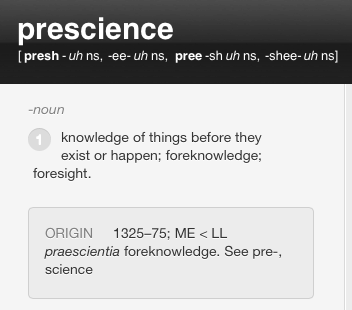
The dictionary definition of the word prescience implies it is somehow possible receive fore-knowledge ahead of when things have actually happened.
We can ’see’ this more clearly when we insert a simple hyphen to get “pre-science”.
It could explain how Leonardo da Vinci was able to sketch helicopters and parachutes. Many other scientists and visionaries seem to receive their insights in visions or even dreams.
Newton ’got’ gravity in a split second and took the rest of his life working out the maths of apples falling to earth. The chemist Kekulé dreamt of a snake eating its own tail and then made the intuitive leap to work out the ring structure of the benzene ring which lead to the basis of all organic chemistry.
For mere mortals, making giant leaps of scientific discovery may not be high on our daily To Do lists. However if we are involved in the creative industries, being able to see the ’near-future’ could have its uses. We could ’see’ what is is we need to create, be it the title and words for a book or the scope and shape of a client’s marketing campaign. If you work in the financial sector, knowing what to invest in is obviously useful. Note that there are reasons why we can’t simply get the lottery numbers.
But how do you go about getting into the state where such flashes of insight pop in?
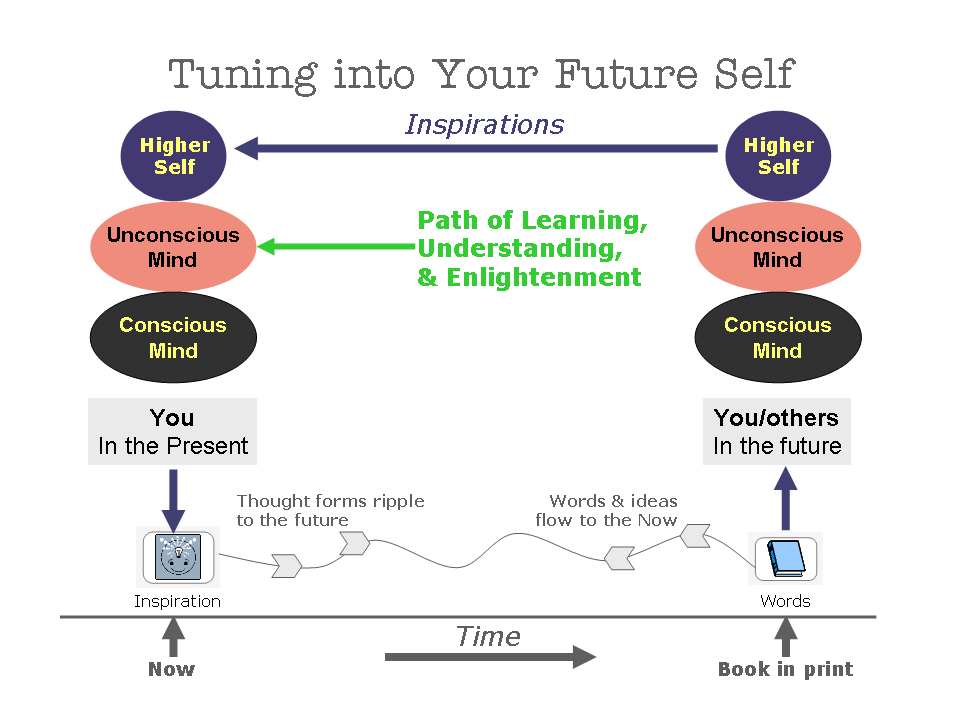
Well the key lies in learning how to enter the meditative state at will – ideally with your eyes open. What then happens is that time and ’The Now’ softens and we find it easier to resonate with both the past and future versions of ’Us’. Rupert Sheldrake describes the mechanism whereby this occurs in his wonderful theories called morphic resonance. By quietening the conscious mind and that inner chatter, past memories become more accessible as do ‘future memories’.
The diagram below shows how an author can tune into the words they have yet to write. If our conscious mind is active, it blocks the flow.
If you don’t know how to meditate and can’t make your mind go blank, help is at hand.
The Manage Your Time with Mindfulness ecourse is designed not only to show you how to stretch time by changing the speed of your thoughts but also how to tune into ‘future memories’.
by Tom Evans | Oct 31, 2012 | Timing
 We are blessed with two minds …
One sits inside space and time, the other everywhere and ‘everywhen’ else.
Listen to this purposely short podcast to find out what happens when we get them working together.

Change the way you think and add hours to your days
Many time management systems teach you how to better prioritise and how to beat procrastination. This system is fundamentally different – it shows you how to change the speed of your thoughts, using meditative and mindfullness techniques, so you change the subjective passage of time.
Learn how to control your own Personal Time Machine – your Mind.
This ecourse contains over four hours of mind altering exercises and visualisations to take you into altered and heightened states of consciousness. The programme is simple to follow, completely safe and also very, very relaxing.
You will also find out that we have different time clocks running all over our bodies!
Take some Time Out to give yourself more Me-Time and you will get your investment back in this revolutionary time management programme in no time at all.
This course on bendy time is based on bendy pricing – you only pay what you can afford
by Tom Evans | Aug 22, 2012 | Timing
 If you are one of those people who has a To Do List which never gets done, the best way to deal with it is to start a “To Don’t” List.
Listen to this Sixty Second Time Tip to find out more …
… and when you are done, make that list and start Bending Time – it comes with a full 30 day refund guarantee so you have nothing to lose but spending a little time to create loads more!!

by Tom Evans | Jul 2, 2012 | Timing
 We give Old Father Time a bit of a hard time. We blame him constantly.
“There are not enough hours in the day.”
“Where did the time go?”
“I would write that book if only I had the time.”
“Time just gets away from me.”
This really unfair on him. He gives us continuity. He allows us to have memories of the past and to dream about the future. He stops everything from happening all at once, which would be ever so confusing for us.
It is humankind, not him, who have enslaved themselves to time. If you wear a watch, you are entrapping yourself ‘in time’. Watch that clock and again, you bond yourself to time. Even our calendar imprisons us in unnatural time. Months of varying lengths are a man-made construct. September, October, November and December should, by rights, be the seventh, eighth, ninth and tenth months of the year. We have the egos of Julius (July) and Augustus (August) Caesar to thank for that anomaly.
Incidentally, we have a perfectly good clock which orbits the Earth 13 times very year with the cosmic precision. When you live your life by 13 Moon Time, I can testify personally you stop pushing water uphill.
Time is not external and imposed upon us. It is generated by our consciousness. If we want to change our interaction with it, all we have to do is change how and what we think. For example, if you fret over past events or worry about the future, you have taken your focus away from what you are working on right now. You will ‘lose’ and waste time.
Old Father Time has become a bit of a punch bag who never complains. He just keeps marching along silently, probably smiling at our naivety at the way we have allowed ourselves to be entrapped by time.
Just imagine though if we could expand time such that we could get everything we wanted done and more. We would have no excuses and nobody to blame. All of a sudden we would be completely accountable for our actions and deeds. This would have massive implications. Time wasters would have nowhere to hide and those that are productive would get even more done.
In just 35 short years, Mozart composed over 600 works, many praised as masterpieces. Bearing in mind he started around the age of 5, that’s 30 or so compositions a year. Now he had no Internet, TV or computer games to consume his time, but that is pretty amazing output by any standards.
It’s said, if you want something done, give it to a busy person. Why this works is that busy people, like Mozart are not frittering time away on other things, they are focussed on getting things done.
For many people, having an external clock superimposed upon them is the most brilliant excuse. The reality is this however. We can all choose to to run our consciousness at a different rate and to get more done in less time. When we do this in a team or group, time dilation effects multiply.
If you sit in your left brain, with your ‘inner devil’ focussed on detail, you get nothing done. When you live a right brained existence with your head in the clouds, nothing gets done either. However, when both brain hemispheres work in harmony, our efficiency increases by 400% or so.
What’s even more amazing about achieving such efficiency gains is that the techniques required are largely free. They involve breathing and learning to get in the zone by entering the meditative state with our eyes open. These techniques also have health benefits by reducing stress and even lowering blood pressure. It’s thought that every minute spent in the meditative state adds at least a minute to our life spans.
So just imagine what you might do and what you might achieve if you no longer had the excuse that there was not enough time. There’s no time like the present to find out.
Living Timefully is a revolutionary time management programme that shows you how to change your experience of time by changing the way you think.
Start Living Timefully today
by Tom Evans | Jun 21, 2012 | Timing
 If you run a business where you charge by the hour, there is a fundamental limit to your annual turnover based on your hourly rate.
Let’s say you could work for 8 hours a day, 5 days a week and 48 weeks a year and you charge £50 an hour. If you were lucky enough to have 100% client bookings, you could earn £96,000 a year. This is not a bad level of income but you might burn out in the process.
This also leaves no time for client acquisition, any admin or even a tea break! Those that are lucky enough to have a full client diary end doing their admin and marketing in the evenings and weekends and end up becoming their own employee.
Now there are some conventional ways out of this quagmire:
- You can outsource your admin
- You can of course put your hourly rate up and do less hours for the same turnover
- You can take on other consultants, train them in your methods and take a percentage of their earnings
- You can even write a book, or design an eproduct or three, and make money while you sleep
There is though a radical and revolutionary way to get more done in less time and, as a result, become more profitable. This method is initially useful where you are billing for work commissioned by the client and not in face to face meetings. When you get confident in the techniques, I will explain how you can pull this trick off in front of a client too!
It’s a common misconception that time is fixed. If you’ve ever been in a waiting room with nothing to read, minutes can stretch into seeming hours. Conversely busy weekends can fly by and Monday come around all too soon.
What and how we think directly affects the perceived passage of time. Spend time fretting about the past or worrying about the future and you will at least half your efficiency and output right now.
On the other hand, when you ’get in the zone’ however, you can double, triple or quadruple your output. So, rather than increasing your hourly rate, you can keep it the same but more of the same work in less time. The client will be happy too, not least as the quality of the work we do when we are focussed increases several-fold.
The secrets of how to pull off this magical feat are revealed in Living Timefully, a revolutionary time management programme. This self study course turns time management on its head. Note that it’s not yet another methodology on how to better prioritise and how to manage interruptions. It shows you how you can change the speed of your thoughts so you can get more done in less time.
The proof of how it works is in tasting the pudding but just imagine if it’s true, how could you use possibly use this in face to face interactions?
When you learn the simple mindfulness techniques, something amazing happens when you switch your internal time clock, the ’clocks’ of people around you also switch to match yours. So, for example, if you have a non-chargeable sales or project scoping meeting, you can reach consensus in half the time. This way you can get back to billing work more quickly.
When you are in a chargeable session with a client they get more from the session and feel they get great value from you. They value their time too so your seeming efficiency, focus and clarity gives you an edge over your competitors. You might even consider putting your rates up when the inevitable testimonials come flying in.
So what are you waiting for? As for planting a tree, the best time to start creating more time is yesterday. The second best time is today!
Create as much time as you need and get more done
by Tom Evans | Mar 14, 2012 | Timing
 Listen to the latest Moments of Light podcast interview with Davina Mackail, author of The Dream Whisperer.
There are so many benefits of using your dream-time to be creative – apart from just being more efficient by using time we think is wasted, the quality of the information you can receive is quite literally ‘out of this world’ …
Listen to this interview to find out how to remember and interpret them and why buying a dream interpretation book isn’t necessarily a good investment …
 Davina Mackail works as a shamanic life coach and healthier home and business expert.
She is also an experienced teacher, writer, presenter and inspirational speaker. Her passion is encouraging the magnificence of humanity and inspiring people to live from their hearts and fulfil their dreams. This has led to a life long study of the human mind, metaphysics, quantum physics, the nature of consciousness, philosophy, psychology and shamanism – a passion that is as much part of her being as breathing.
Her book, The Dream Whisperer, is published by Hay House will help you unlock the treasure house of your dreams.
The Dream Whisperer on Amazon.co.uk
Find out more about Davina and her magical work on her web site AskDavina.com
by Tom Evans | Jan 3, 2012 | Timing
 This is probably the trickiest of all the blocks in this this series so far that stop people being creative as it’s the most subjective.
For example, one person might love your writing, music or art and another may loathe it. The former will appreciate your talent and the the latter think you don’t possess an ounce of it.
So one simple way to boost your perception of your talent is just to find the people who like your stuff. When you do find them, watch out for sycophants and the perils of an ego that comes from having a fan base – remember it might be temporary.
When you get reviews, remember to thank people for them.
From an objective perspective, there’s a bunch of really practical things you can do to improve and hone your talent.
The first three might not normally be associated with the arts but they are as follows:
- to get regular exercise
- to eat the right things
- to breathe using your diaphragm
Each of these increases the nutrients reaching your brain which in turn facilitates increased interactivity between your neurons. By the way, the exercise doesn’t have to be strenuous, a brisk walk with diaphragmatic breathing is enough – this is why I recommend writers should be dog owners. And when you walk, if you can, look up not down – it makes a huge difference.
Now onto honing your talents themselves … here’s my top seven tips
- Practice … and then practice some more
- learn how to Mind Map (properly)
- create something each day
- have an Artist’s Date per week – see Julia Cameron’s Artist’s Way site
- when you read, see or hear something you like, spend a little thinking about what you like about it
- then plagarise, copy and emulate a style you like … making your own fusion along the way
- don’t hide your reviews away, pin them on your wall, post them on your web site, Tweet them
Finally remember the best way to hide your talent is not to create anything at all … and that your talent is a gift and natural endowment, not to be hidden under a bushel or suppressed by any of the fears in this series.
In any case, it should be remembered that these fears are only there to give us the indication that there’s something we need to tackle and embrace.
by Tom Evans | Jan 2, 2012 | Timing
 One of the most common complaints you hear nowadays is that there is not enough time.
The world is speeding up – we are being bombarded by TV, news, social media – how is it possible to keep up?
Well it’s a common misconception that the march of time and it’s ticking clock is both fixed and immutable.
You hear people saying things like, “You can’t change the past” and “There are simply not enough hours in the day.”
Both these statements are not necessarily true.
It’s also said that, if you want something done, give it to a busy person. I even heard someone say once that they didn’t have enough time to read a time management book !!
Well there’s two books I recommend highly both that take a different approach, mentioned at the bottom of this blog … but even they don’t really show how time can be bent, managed and stretched.
It’s all in mind
Now this might seem far fetched, or in the realms of Doctor Who or Back to the Future, but scientists are coming to the conclusion that our reality – our space and time – are linked to our consciousness. In fact, it’s more accurate to say that it’s our very consciousness that actually creates our reality and space and time. So all you need to do to change time is to make a change in your consciousness.
A fly and an elephant both perceive time differently to us … and I for one have noticed a difference in peoples’ cognitive reaction time. Have you ever tried to swat a fly only for it to seem to know where you are about to strike? It’s nerve signals don’t have to travel as far as ours so its physiology and neurology means it reacts quicker.
I am sure you have heard about athletes who have been “in the zone” – a sort of timeless place – or perhaps you have had a light bulb moment where in less than a second, you get a flash of inspiration – a whole picture for a new idea. If you were able to MRI scan your brain at this moment, you would see both the right and left hemispheres light up in synchronism. For that split second you were Whole Brain (or even Whole Mind) Thinking. A brain scan would show that your brain was generating alpha and probably even theta waves.
It is now thought our left brain sits in space and time and our right brain everywhere and “every-when” else. By making our left brain go silent and work in harmony with our right, our perception of the speed of time changes.
Now you can access this state while meditating. When I mention this to people, their first reaction is that they don’t have time to meditate. I know it sounds counter-intuitive but I can testify that 20-30 minutes meditation before any creative session will deliver not only the time back by a factor of 3 or 4 but also produce the most sublime output that appears to have come from nowhere.
“But I can’t make my mind go quiet,” is normally the next protest swiftly followed by, “I’d like to meditate but I don’t have time to learn how.”
Well, if you hear yourself saying this, help is now at hand. You don’t need necessarily to enter an ashram for two months. Although, if you did, it might well be time well spent …
Have a listen to this audio track to learn a routine you can use anytime and anywhere – great also for getting back to sleep in the early hours – but not as one client of mind did for listening to while driving !!!
By practicing getting into this state while your eyes are open, you will find time changes its speed … and you will get more done in less time !!!
Create as much time as you need and get more done
Recommended Reading
If what I’ve written above it just too whacky and you just want to better manage your day and “claw back” time, then read Time Management for Dummies by Clare Evans (no relation).
I also recommend getting hold of a copy of Steven Taylor’s excellent book called Making Time – it explains in some detail how consciousness and time are interrelated and how you can start to control time to your advantage.
by Tom Evans | Jan 1, 2012 | Timing
 This fear is one that can be the most debilitating. Say for example you are an author and you’ve cracked all the other fears and finished your book.
You may even have it printed and published … but maybe it’s not selling and you’re struggling to promote it … and yourself.
This is a fear that I have experienced first hand. One of the reasons I discovered about why it affected me so much was that when I was the most financially successful in my life with two businesses, this was when I was also the most stressed.
So I directly equate success with stress and used my creative mind to avoid success at all costs.
The signs that this is happening in your life are:
- You jump on to the next project without really finishing off the last thing you were working on
- You work on behalf of other people before you get on with your own stuff
- You become a ‘busy fool’
And I am proud to say I have all these T-shirts.
Strategies for Getting over the Fear of Success
1. Redefine what success means to you – it doesn’t have to be about the financials and, of course, being successful without the associated stress is a success in its own right
2. Get in the habit of celebrating all milestones no matter how small and in what ever manner you feel, e.g. every review I get for my books, I proudly share on Twitter and Facebook
3. Have a listen to this short visualisation on Becoming Fear-less