Here’s a short ‘read’ for the weekend – I say ‘read’ as this one’s a listen !!
This is the first in the 100 Years of Ermintrude trilogy which you can listen to for free – it tells of the life of a woman backwards – it is poignant and thought provoking.
“Stunning. I cried. That’s all !” said one man about it.
“You’ve captured the zeitgeist of every age,” said another.
– or it is also available in text and with audio for your iPhone and iPad if you want a copy to keep and take around with you to share with others
One of the most amazing feats we can perform is to consciously control which parts of our brain we are using.
Once mastered, you can then put this under ‘unconscious control’ and increase your creativity several fold.
A good example of this is when you learn to ride a bike or drive a car. Once learned, you can do something else and multitask without having to give what is an amazingly complex task a second thought.
Now I should say the the whole left and right brain model is both simplistic and only serves to help us understand that we can be in different states of mind. Our left and right brain functions are caused by our state of consciousness not the generators of it and what is processed by the physical left and right are nowhere near as separate as perhaps currently thought. It is a good approximation thought to help us get our mind around what is one of the most complex structures we currently know of in the Universe – our own brains.
In simplistic terms, however, what happens is that the right brain learns a process and hands it to the left to handle automatically.
To understand how the right and left interact, do the following exercise:
Step 1: Write down the word MAGIC on a piece of paper
Step 2: Then write it down two more times
Step 3: Now write it down backwards
Step 4: Then write it down backwards two more times
Step 5: Notice how when you wrote the new word backwards for the second and third time how much you speeded up, probably copying the word you first wrote. Notice how the third time was even quicker than the second time.
Note that I haven’t purposely written it down backwards in this blog as this would spoil the effect. What is happening is something like this.
Step 1: your right brain decoded the sentence above and sent it to the left to handle
Step 2: the left brain repeated the task twice with a modicum of right brain holistic supervision
Step 3: either your right brain forms a whole picture in your mind’s eye of MAGIC backwards and then tells the left brain to write it OR your right brain gets your left brain to write each letter down and then forms the picture of it backwards – perhaps correcting itself with the position of the A and I and G and M after the first attempt
Step 4: when you repeat it, your left brain either copies what it sees on the page or uses the right brain whole image and processes the whole synthesised word
Now repeat the same exercise with the word POWER but this time do it with your eyes closed to experience the difference.
Now this might all sound a bit trivial and we perform complex actions like this every day without giving them a second thought. Just being able to do this is magical. If you really think about it, being able to comprehend that we are doing it is even more magical – and the beginning of a new level of mind control.
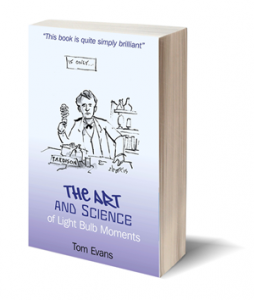
If you would you like to learn more about these techniques, make sure you get a copy of Tom’s new book to find out where ideas really come from and how you can make sure yours actually happen …
Research has shown that there is a connection between what we eat and how we feel. The biochemical basis of this food-mood link lies in the chemical messengers, called neurotransmitters, that relay thoughts and actions along the neural pathways of the brain.
As food affects the action of these chemical messengers it can also have an impact on our mood. Nutrient choice is therefore important to support the thought process. Meal timing, portion sizes and the combination of foods, play a vital role in the regulation of mood and energy. They influence blood-sugar levels which can leave us as high as a kite one minute and scrambling through the cupboard the next, in search of a sugar fix
For this next exercise, look at how your food affects your creative performance. Like many of the exercises in this book, the benefits to be had by this approach will have an impact on other areas in your life.
Go Low Glycemic
Carbohydrates, in particular, affect our energy levels and mood. High sugar products raise blood sugar for a short period, always followed by a dip that leaves you unfocused and lethargic.
Low-glycemic carbohydrates (e.g. brown rice, pasta, vegetables), on the other hand, provide more stable energy and mood levels. Small portions of complex carbohydrate at regular intervals throughout the day will be effective in regulating energy.
Glycemic Index (GI) refers to the rate at which sugar from a particular food enters the cells of the body. Foods with a high glycemic index stimulate the pancreas to secrete insulin, quickly emptying sugar from the blood into the cells. This produces the familiar ups and downs of blood sugar and the roller coaster energy levels that go with it. Foods with a lower glycemic index do not push the pancreas to secrete so much insulin, so blood sugar tends to be steadier. Eating low GI foods and combining carbohydrate with protein and fibre will reduce the rate at which sugar empties into the cells.
You should, therefore, combine low GI carbohydrates, protein and vegetables or fruit in each meal or snack sitting. Some good examples are:
Chicken, brown rice and roasted vegetables
Salmon, couscous and greens
Wholemeal pitta with tuna and salad
Nuts and fruit
Wholemeal cereal and semi-skimmed milk with fruit
Meal Patterns
The most effective way to keep energy level even across the day is to spread your calorie need over five to six small meals, rather than the traditional three. This can help you avoid the commonly experienced mid-morning and mid-afternoon energy dips that leave you lacking concentration and focus.
Unsurprisingly, the most common time for people to visit the office vending machine is mid-afternoon, as those who have not eaten a healthy lunchtime snack are on a mission to get a sugar-fix.
Prepare some healthy snacks in the morning so that your work-flow is not interrupted when you sit down to write, and think carefully about which nutrients you select for a brain boosting breakfast, lunch and dinner.
Foods With The Best Brain Balance
Fruit such as grapefruit, apples, cherries, oranges and grapes have a lower glycemic index. Fruit has a lower GI than fruit juice, because the fibre in the fruit slows the absorption of the fruit sugar. A whole apple will therefore be more brain friendly than apple juice.
For cereals and grains, oatmeal and bran have the lowest GI. Other foods with a favourable GI include spaghetti and brown rice. Corn flakes and sugar-coated cereals have a high GI and are therefore not ideal.
Vegetables, soybeans, kidney beans, chickpeas and lentils have the lowest glycemic index of any food. White potatoes have quite a high GI so try to opt for sweet potato instead.
Finally dairy products, milk and yoghurt have a low GI, slightly higher than vegetables but lower than fruit. Plain yoghurt has a lower glycemic index than flavoured yoghurts with added sugar.
Happy foods
During the winter months we are starved of sunlight and this can lead to a reduction in the release of serotonin, an important chemical found in the brain. Serotonin is referred to as the feel good hormone and reduction in its release can lead to the development of serious seasonal depression for some, or just a dip in mood for others. Interestingly, our food intake also has an impact on the release of this hormone and tweaking our diets can lead to an improvement in mood, or halt this dip altogether.
Particular foods have a calming effect on the body that results in heightened feelings of happiness. Chocolate can have this effect as it triggers the release of serotonin and endorphins that make us feel good. Other happy foods include chicken, milk, leafy green vegetables and bananas which all contain a compound called tryptophan.
Tryptophan is an amino acid and one of the building blocks of protein. It competes for access to the central nervous system, with several other amino acids, and it is thought to increase the brain’s production of serotonin, and subsequently to elevate mood.
It is known as Nature’s Prozac.
Perky Foods
Proteins in the diet affect brain performance, either leaving us alert and productive or ready for bed. Rich foods can make us feel alert, jumpstarting the brain so we are ready for action.
Another amino acid that increases neurotransmitter activity is Tyrosine. High tyrosine foods include seafood, soy, meat, beans, tofu and eggs; eating them can leave you focused and motivated.
Essential Fatty Acids
Essential fatty acids (EFAs) also play a role in mood regulation. Those with low intakes of Omega 3 fatty acids have been found to be more likely to experience Seasonal Affective Disorder (SAD) during the winter months. Three to six grammes of EFAs – taken in the form of food like fish, avocado, nuts or supplements – are recommended for general health and mood promotion.
Water, Water Everywhere
Drinking enough water will also make a dramatic improvement to energy levels. Aim to sip on small glasses of water throughout the day. If you don’t want to interrupt your train of thought by nipping into the kitchen to re-fill your glass, fill a litre sports drink bottle and sip one over each half of the day.
If you would you like to learn more about these techniques, make sure you get a copy of Tom’s new book to find out where ideas really come from and how you can make sure yours actually happen …
Mind Maps are useful and elegantly simple devices.
In essence, Mind Maps are simple drawings or sketches of associations you hold between things in your mind. They normally start with a central topic, either in words or even better if expressed as an image. You then draw branches off from that image of the concepts that spawn from the central image.
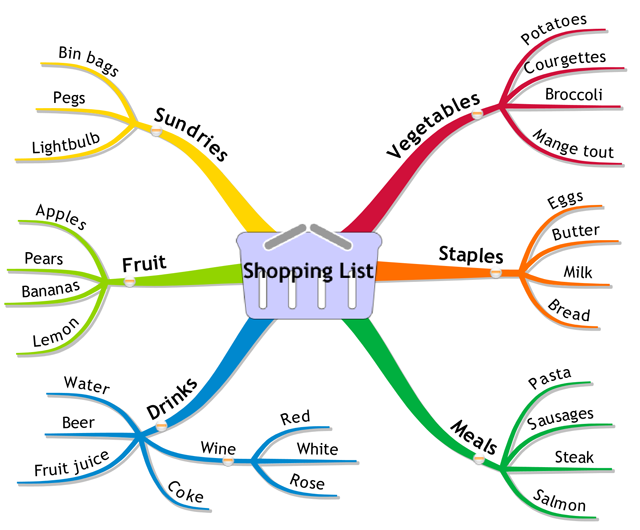
So if you Mind Mapped something relatively trivial like a shopping list you might have a central image of a shopping trolley and branches such as fruit & veg, household, frozen food, beer & wine, dairy and desserts. You can see what my typical shopping list is like. To make it even more memorable, you can use images of products on each branch.
What makes such a trivial Mind Map so powerful is that with a little training, you can forget to take the shopping list along, yet easily memorise all of its contents. I always Mind Map any talk I give on a single sheet of paper and am then able to reproduce all the points I want to get across without any notes or slides.
How do Mind Maps work
You can just imagine the internal dialog between the hemispheres when you are Mind Mapping.
The left brain says to the right brain, “Aha, a map! I do the map reading around here, leave this to me.”
The right brain, seeing that the left brain is busying itself in the detail says, “Great, now I can be truly creative.”
The same type of ‘dialog’ occurs when we are painting or writing or when we’re typing on a computer or using a mouse or tablet.
So most of our days are spent flipping from one hemisphere to another. It used to be thought that the structure called the corpus callosum mainly passed information between both sides of the brain. Current wisdom is that it actually suppresses one side while the other carries out a task. The map gets both sides of the brain in on the action.
Their real power is unleashed when you map associatively, i.e. using one word per branch, as this takes you off in unexpected directions and mimics our neurons’ interconnective structure.
“It is my firm belief that every brain is, by nature, a Mind Mapper! The fact that a baby learns a language is evidence confirming that it must learn by multi-sensual images and their radiating associations. I also believe that everyone contains the full set of multiple intelligences.” – Tony Buzan
Although there are many good software-based Mind Mapping tools on the market, some of the best Mind Maps are done with just coloured pens, pencils and paper. The reason for this is that some people can end up in a left brained mode simply by engaging with a computer keyboard, screen and mouse. When we have a pen or pencil in our hands not only do we use different neural pathways in our brains but the map manifests into physical, as opposed to virtual, reality. This leads to a better chance of your map leading to real world results. If however you do want use computer software, make sure you print your maps out and stick them on a notice board or wall.
“Be aware that many so-called Mind Maps are really just brain maps. Only when you engage in Whole Mind Not-thinking do you truly engage with the mind as opposed to just the brain.” – Me
When it comes to whole brain thinking, the impact of Mind Maps is explosive in the context of the creativity they seem to unleash. They are also really useful for aiding memory and brilliant for anyone studying and revising. If you do have children, my advice is to get them Mind Mapping as soon as possible.
Embedding Mind Maps in your Neurology
If you have a Mind Map you’ve already completed, you can use this visualisation to help you both remember it and to better notice serendipities linked to its contents
If you would you like to learn more about these techniques, make sure you get a copy of Tom’s new book to find out where ideas really come from and how you can make sure yours actually happen …
Cross crawling is actually something we kind of do naturally when we go for a walk. This is why the simple act of a good brisk walk is such a great way to get inspiration – apart from anything else, it gets you breathing!!
This exercise is in two parts which can be done separately, or combined if you feel particularly energetic. It seems appropriate linguistically to call them steps.
Step 1: Walking
If you are able, go for a 10 to 20 minute walk each day, either before you start a creative activity or, especially, if you hit a creative block.
For at least five minutes of the walk, swing your arms from side to side in front of your body. Depending on your physical ability – and where you are doing it – this movement can be as small or large as you feel comfortable with.
Step 2: Cross crawling
You can do this exercise in the comfort of your own home and it important that you do it slowly and you only go as far as is comfortable.
1. Stand with your arms to the side and let the tension fall from your body. Feel the floor with your feet.
2. Now bend your right leg at the knee and swing your left arm in front of you across your navel and, if you can, touch your left elbow to your right knee.
3. Let your right leg fall gently and your left arm return and now bend your left leg at the knee and touch your right elbow to the left knee. Again make sure your left arm crosses your navel.
5. Try to repeat the exercise 10 to 20 times for each side.
If you find it difficult or you seem to get your sides mixed up like tapping your head and rubbing your stomach, don’t worry. This just means your left and right hemispheres really need this exercise. Either really slow the movements down or try it lying down. It will come in time.
I first did this exercise over 10 years ago and after the exercise I briefly started mirror writing. This is often a trait seen in those categorised with dyslexia. If it happens to you, take it as a sign that new pathways are opening up in your brain.
Less Strenuous Versions
Note if you are physically infirm or unwell and either of these exercises is either impossible or likely to cause you harm, instead of getting your elbow and knee to touch, you can just tap your opposite knee with your hand as shown here. This has much the same effect.
What is most bizarre though, if you not able even to do this reduced movement version, you can actually get some benefit by closing your eyes and imagining you are carrying them out – as observed and supervised below by a professionally qualified ‘cross-crawler’ who takes me on ‘training sessions’ daily – although I labour under the illusion that it is me who walks him.
Such is the power of the mind.
If you would you like to learn more about these techniques, make sure you get a copy of Tom’s new book to find out where ideas really come from and how you can make sure yours actually happen …
Many people ask me how they can be more inspirational or can experience more inspirations. The answer is perhaps surprising as it doesn’t lie being more intelligent or studying. It involves doing something we all do every day, without thinking about it, and that’s to breathe.
Of course, this is quite handy as we all breathe anyway to stay alive.
What brought me to this realisation was some research I did around the actual word, inspiration. Our words and our sayings give away much about their true semantics.
If you look up the word inspiration say at www.dictionary.com, you will see the following definitions:
1. an inspiring or animating action or influence:
2. something inspired, as an idea.
3. a result of inspired activity.
4. a thing or person that inspires.
5. Theology.
a. a divine influence directly and immediately exerted upon the mind or soul.
b. the divine quality of the writings or words of a person so influenced.
6. the drawing of air into the lungs; inhalation.
The first four you will probably have expected but it’s maybe a surprise to see that there is a theological connotation for inspiration. The last definition is one that most people don’t think of even though it’s perhaps fairly obvious. Inspiration is of course one half of the respiration process.
Further insight comes from looking at its etymology, or root meaning. You find that the word ‘inspiration’ is comprised of the word “in” and the Latin “spirare”which meant “to breathe”.
Now I was aware we speak on the out breath. Could it be that ideas come to us on the in breath? I did some more research and found that Eastern mystical practices such as Taoism use breathing exercises in meditation to both balance Yin and Yang energies and encourage the connection to the divine.
Whole Brain Breathing
Now our neurons don’t store any oxygen but they need oxygen in order to function. So guess what? If you increase your depth of breathing by really using your diaphragm, your brain gets more oxygenated.
Now you don’t have to do this all day but it’s a great thing to do as you get up and when you need an shot of inspiration – for example, if you flag in the afternoon.
Here’s the sequence to follow:
1. Place your hands on your belly so your fingers tips on your left and right hands are touching
2. Now breath in so your belly really expands and your finger tips separate
3. Next breath out fully with your out breath being about 3 to 4 times longer than the in breath – and then your fingers touch again
4. Repeat this nine times
5. If you want to get a bit fancy, on one breath, imagine the oxygen filling your left brain and on the next, the right – alternate this sequence and see if you can work up to 18 breaths in this way
If you would you like to learn more about these techniques, make sure you get a copy of Tom’s new book to find out where ideas really come from and how you can make sure yours actually happen …

 100 Years of Ermintrude

 Cross crawling is actually something we kind of do naturally when we go for a walk. This is why the simple act of a good brisk walk is such a great way to get inspiration – apart from anything else, it gets you breathing!!

 Many people ask me how they can be more inspirational or can experience more inspirations. The answer is perhaps surprising as it doesn’t lie being more intelligent or studying. It involves doing something we all do every day, without thinking about it, and that’s to breathe.