by Tom Evans | Jun 21, 2012 | Timing
 If you run a business where you charge by the hour, there is a fundamental limit to your annual turnover based on your hourly rate.
Let’s say you could work for 8 hours a day, 5 days a week and 48 weeks a year and you charge £50 an hour. If you were lucky enough to have 100% client bookings, you could earn £96,000 a year. This is not a bad level of income but you might burn out in the process.
This also leaves no time for client acquisition, any admin or even a tea break! Those that are lucky enough to have a full client diary end doing their admin and marketing in the evenings and weekends and end up becoming their own employee.
Now there are some conventional ways out of this quagmire:
- You can outsource your admin
- You can of course put your hourly rate up and do less hours for the same turnover
- You can take on other consultants, train them in your methods and take a percentage of their earnings
- You can even write a book, or design an eproduct or three, and make money while you sleep
There is though a radical and revolutionary way to get more done in less time and, as a result, become more profitable. This method is initially useful where you are billing for work commissioned by the client and not in face to face meetings. When you get confident in the techniques, I will explain how you can pull this trick off in front of a client too!
It’s a common misconception that time is fixed. If you’ve ever been in a waiting room with nothing to read, minutes can stretch into seeming hours. Conversely busy weekends can fly by and Monday come around all too soon.
What and how we think directly affects the perceived passage of time. Spend time fretting about the past or worrying about the future and you will at least half your efficiency and output right now.
On the other hand, when you ’get in the zone’ however, you can double, triple or quadruple your output. So, rather than increasing your hourly rate, you can keep it the same but more of the same work in less time. The client will be happy too, not least as the quality of the work we do when we are focussed increases several-fold.
The secrets of how to pull off this magical feat are revealed in Living Timefully, a revolutionary time management programme. This self study course turns time management on its head. Note that it’s not yet another methodology on how to better prioritise and how to manage interruptions. It shows you how you can change the speed of your thoughts so you can get more done in less time.
The proof of how it works is in tasting the pudding but just imagine if it’s true, how could you use possibly use this in face to face interactions?
When you learn the simple mindfulness techniques, something amazing happens when you switch your internal time clock, the ’clocks’ of people around you also switch to match yours. So, for example, if you have a non-chargeable sales or project scoping meeting, you can reach consensus in half the time. This way you can get back to billing work more quickly.
When you are in a chargeable session with a client they get more from the session and feel they get great value from you. They value their time too so your seeming efficiency, focus and clarity gives you an edge over your competitors. You might even consider putting your rates up when the inevitable testimonials come flying in.
So what are you waiting for? As for planting a tree, the best time to start creating more time is yesterday. The second best time is today!
Create as much time as you need and get more done

by Tom Evans | May 7, 2012 | Illuminating
 If you read and acted on the last post in this series, Seven Ways to Block Light Bulb Moments, well done – you’ve set up the conditions whereby light bulb moments to come your way.
Rather than waiting for them to come in randomly though, there’s a few things you can do to stir them up and encourage them to occur.
________________________________________________
1. Environment
There is clutter and clutter. A completely sterile and clinically clean environment might look nice but will not stimulate the brain. On the flip side, a desk with piles of unfinished business piling up in an In Tray or covered in Post It Notes of things to do, can have a negative effect. A balance is recommended which implies a buzz is happening with positive results and sales wins are clear for all to see. Fill your office with creative resources such as white boards and a book library and ensure a room or space is available for people to meet and be inspiring.
2. Celebrate Success
In our busy days, we sometimes forget to take time out to pat ourselves on the back. This doesn’t mean you have to take the whole team down the pub every time you get a sale in. Have a stack of Mar Bars or a pile of iTunes or Amazon vouchers and dish them out appropriately.
3. Map your Minds
Mind Mapping is one of the most powerful and coolest tools for stirring up creativity. They can either be used for free association or to get your thoughts in order, plan a project or design a product or service. See Mapping your Mind for more on this. They become especially powerful when you work on them collectively and collaboratively. The maxim two heads are better than one grows exponentially when more heads get involved.
4. Appreciative Review
We can spend a fair amount of time analysing what went wrong. The culture of public enquiries and tendency of the press to report everything that’s bad just serves to fuel this type of negativity. When something ‘goes right’, there is much to be gained from working out what you did that was so good and then applying that wisdom to other processes in the business. Different parts of the brain get involved with this process and you will be amazed at the results.
5. Breathing
Breathing is something we all have to do, yet most people breathe very shallowly. Our neurons don’t store oxygen yet need it to function so learning to breathe properly and to pump prime your brain has great benefits to both creativity, health and well-being. Listen to this Getting in the Zone visualisation for 11 minutes – and why not play it at the start of your next creative meeting.
6. Meditation
Many people think it’s impossible to meditate and make their minds go quiet. In our busy days, the idea of wasting 10-20 minutes meditating sounds horrendous. I can testify personally that the days that I don’t meditate don’t flow so well and that when I meditate my days seem to be full of good luck, chance encounters and clients that seem to find me ‘by accident’. Listen to How to Quieten Your Mind to experience the meditative state.
7. Trust your Gut
The most successful business people pride themselves on trusting their gut. It is now known by neuroscientists that our gut has more neurons than a cat’s brain and works about 5 to 10 seconds ahead of our conscious awareness. Using a combination of right breathing and meditation, you can tune into your gut mind and communicate ‘consciously’ with it. The results you get from learning this technique are simply mind blowing.
More resources and articles
What blocks light bulb moments
Generating Spin Offs
by Tom Evans | Mar 14, 2012 | Timing
 Listen to the latest Moments of Light podcast interview with Davina Mackail, author of The Dream Whisperer.
There are so many benefits of using your dream-time to be creative – apart from just being more efficient by using time we think is wasted, the quality of the information you can receive is quite literally ‘out of this world’ …
Listen to this interview to find out how to remember and interpret them and why buying a dream interpretation book isn’t necessarily a good investment …
 Davina Mackail works as a shamanic life coach and healthier home and business expert.
She is also an experienced teacher, writer, presenter and inspirational speaker. Her passion is encouraging the magnificence of humanity and inspiring people to live from their hearts and fulfil their dreams. This has led to a life long study of the human mind, metaphysics, quantum physics, the nature of consciousness, philosophy, psychology and shamanism – a passion that is as much part of her being as breathing.
Her book, The Dream Whisperer, is published by Hay House will help you unlock the treasure house of your dreams.
The Dream Whisperer on Amazon.co.uk
Find out more about Davina and her magical work on her web site AskDavina.com
by Tom Evans | Mar 6, 2012 | Illuminating
When I trained as an iMindmap Instructor a few years ago, I was introduced to the concept of limiting each branch of the map to a single word. At first, I didn’t go along with this idea as I thought the application of any ‘rule’ might limit the creative flow. Once I learned, however, to see it as a discipline as opposed to a draconian rule, the benefits and reasoning behind it became crystal clear.
A year or so ago, I was stuck on chapter 9 of of my book on Light Bulb Moments. It wasn’t flowing so I used Tony Buzan’s technique of free association Mind Mapping on the words “light”, “bulb” and “moment”. Now had I mapped using the phrase “light bulb moment”, my mind might have been lead to “Edison” and then “phonograph” or “Topsy the Elephant” (Google it) or to “Eureka”, “Archimedes” and “bath water”.
Instead, as you can see on the map below, “Bulb” took me to “tulip” and to “Amsterdam”. The word “Moment” in isolation made me realise we have a moment in time and the moment of a lever around a fulcrum. As a result, I started a series of podcasts called “Moments of Light” in which people talk about how they had a light bulb moment and did something with it.
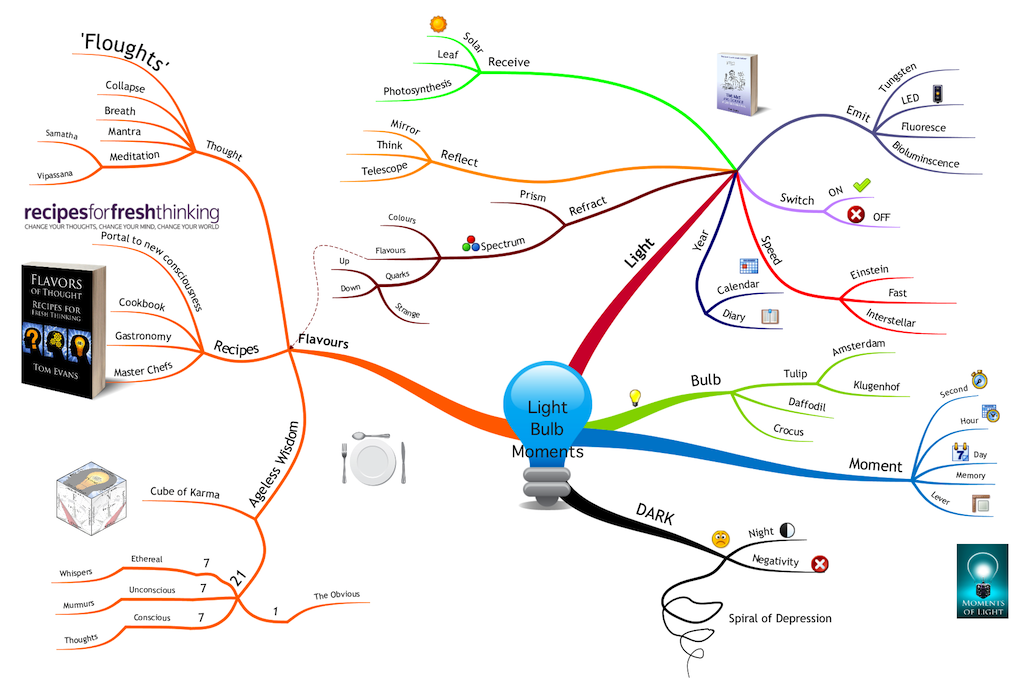
The word “light” as you might imagine provided a deep and wide source of metaphor and association. Light of course can be split into a spectrum of component colours. It made me realise that quantum physicists ascribe many attributes like spin, colour and flavour to exotic particles like quarks. Then a light bulb moment came in.
Is it possible that thought itself has properties like colour or flavours?
At that point, the writer’s block vapourised and the result was a chapter called “Flavours of Thought” which I didn’t plan to write. This led to writing a whole book of the same name a month later that I didn’t plan to write either.
As chefs use a mix of flavours in their concoctions, I also combined the flavours of thought into various recipes too. As a result, about a year later a membership site appeared on the scene called “Recipes for Fresh Thinking” that I didn’t plan to build. I started training “Master Chefs of the Mind” to solve many common mind-based issues prevalent in every day life.
I then came across some esoteric material on something called the Cube of Space. I found I could map my Flavours on to the Cube. As a result, I found I had from nowhere created an amazing tool for personal evolution and advancement. This in turn lead to a new practitioner programme called the Cube of Karma that I had no plan in developing. I see it now as a gastronomic recipe of all the flavours of thought.
None of this was planned, none of it was foreseen. This all shows the power of a true Mind Map.
Related Links:
The Art and Science of Light Bulb Moments
Flavours of Thought
by Tom Evans | Feb 10, 2012 | Scribing
 You would be forgiven to think that someone who has published eight books on Kindle would know all that there was about publishing and Amazon’s KDP platform.
Well let me disavow you of that notion.
Sure I know how to write a book, format it and upload it for sure but when it comes to book promotion, I confess that I pretty much make it up as I go along – I am still learning.
Now I had pretty good initial success with my latest book, This We Know. A month after I wrote and published it (incidentally which took less than a month), the book got over 30 reviews [UK & US] and not a bad ranking in the charts in its genre.

Since then, like many books, it’s been sliding down into the Amazon noise floor. Like many authors, I was getting despondent and wondering what to do and what I was doing wrong.
Finding Udemy
Then out of the blue, I had an email inviting me to look at Udemy. Less than a month later, I had uploaded three of my own courses – see here … but then a real bonus came in.
I started to connect with other fabulous instructors and to discover their marvelous course materials. One that jumped out and grabbed me straight away was Cathy Presland’s course – Publish Your Book on Kindle
Not only does it cover everything you need to know about formatting your book, which is great if you haven’t done it before, but there’s a whole load of really useful information for “old hands” like me on selling and promotion.
I’ve only implemented a couple of the tips this weekend and already sales have started to come in again – eternal thanks Cathy.
I love too the way you share success stories of your students – you are a god send to all authors.
Five Things I Didn’t Know About Publishing on Kindle
- How to get eyeballs on my book
- How to do a proper Best Seller campaign
- How I am not the only one to have made mistakes in the past, so not to give myself such a hard time
- How to get people to sign up to your email list from your book – courtesy of Steve Reeves
- How it can lead to creating passive income from your writing & blogs – courtesy of Tom Ewer
So whether you are a new author starting out or an existing author, this course should be high on your list of investments this year.
p.s. I am only recommending this course because I purchased it myself.
p.p.s. This is an affiliate link so there is a revenue share for me if you decide to purchase it too. I am pointing this out because if you like the course, as much as I did, you can do just the same.
by Tom Evans | Feb 5, 2012 | Illuminating
 There are several states of being that stop light bulb moments in their tracks. I say ‘states of being’ as they are not limited to our state of mind. Light bulb moments are whole body phenomena.
The diagram below shows the main sources of blockages and also the area in our bodies in which they are mainly sited. Note that there is not only a fair bit of overlap between these sites but also a huge amount of cross-communication too.
Starting from the bottom up, if we are in a desperate state the lights are switched well and truly off. When we are in danger, the flight or fight response kicks in at the limbic centres of our brain and no amount of creativity can see the light of day. This is unless, of course, you are trained in a martial art where you have learned to control these base instincts. With just some basic training, we can indeed work inspirationally about how we handle pressure situations. The keys to becoming a master of such arts overlap considerably with the skills that conjure up light bulb moments on demand.

If you are in pain or discomfort, creativity can fly out of the window. A toothache perhaps affects an area of just a few square millimetres but it can put your whole mind in abeyance until you get it sorted. While you are in that dentist’s chair, you probably won’t be composing an opera. Somewhat ironically, if you could manage to do so, it would make the time go much faster.
Moving upwards on the diagram now, a secure environment sets the seeds for inspiration to flow. If you are in a workplace where you are underpaid (hungry for money) your creativity will be stifled. This can be exacerbated if there is a lack of recognition in your home or personal environment where you can’t share your achievements. One of the benefits of the Internet and social media is the ability to share your talents with a larger community should your local connections not recognise your genius.
Fears which we mainly store in our gut are the next causes of blockage.
If we were ever told an essay was poor by a teacher, this memory can stay with us for years. If you find someone else is getting you to write sales proposals or difficult customer emails, you can bet they had this experience at school.
Similarly, if our peers laugh at our attempt at art or music, we might never pick up an instrument or a brush again.
If you don’t try, you can’t fail so procrastination is also a marvellous success avoidance strategy. The other one is being a busy fool, perhaps starting loads of projects but never finishing any.
The two times in my life when I have been the most financially successful were co-timed with the points in my life when I was most stressed. Accordingly, fear of success has been with me for years and I have only just finally dealt with it now I am the other side of my half century.
We move now to our heart. The observant amongst you will notice these sites of imbalance and blockage are also sometimes referred to as chakra points.
If we are grieving or unloved, it is not time to start that novel. That is, of course, unless you are using the writing process as catharsis. A sad heart will reflect in your work. People who see your paintings, hear your music or read your words will pick it up in their hearts first as opposed to their heads. Again, if you want to induce this feeling, it is possible to temporarily recall that time of sadness while you are working. The ability to empathise and associate yet with detachment is the sign of a true master of their art.
We leave now the areas in our body that, for the most part, operate outside our conscious control yet that can affect us greatly. These centres evolved last in our evolution along with the ability to speak and the ability to be self-aware and think. The two are interlinked and often mimic each other. I am sure you have met someone who has to say something in order to think it through.
The very act of talking can suppress creativity, for the time we are actually speaking at least. This is especially if the thing we are talking about is of little consequence. If, however, you are an entertainer and your voice is your art, the opposite is true. The subtlety here is that any inspiration comes in on the in breath while we are not talking. The reason for this is that we speak on the out breath and there is a periodicity to the flow of creativity. Our aspirations flow on the out breath and inspirations come on the in breath or the still point between the in and the out. This flow is so subtle that is difficult to detect and tune into. Once you do though, the difference between external inspirational guidance and internal thought becomes clear.
As well as actual speech, there is self-talk. I am sure we have all been in a situation where someone is talking and we’re not listening but working out what we are going to say next. This is natural but while doing this it’s difficult to have a massively creative spurt on what to say next. It might sound counter intuitive but by truly listening to what the other person is saying, we have a better chance of replying with something erudite and off the cuff. We just have to learn to trust in the process and to trust ourselves. There is many a time when you can just listen and the other person will tell you at the end what a fabulous conversation they just had.
When we are by ourselves, we often have inner conversations. We might be rehearsing a speech or a talk or replaying a conversation where we wished we’d come up with a wittier and more incisive retort. From a light bulb moment perspective, this inner chatter – which is also referred to as the Monkey Mind – is an anathema. Later in this series, I will be showing you the arts of Whole Brain Thinking and Whole Mind Not-thinking and how to make the Monkey Mind quieten down and go for a rest.
Only when your mind is silent can the light bulb moments come in. This is of course why in the normal run of things light bulb moments occur when you aren’t expecting them. Perhaps you are driving, dreaming or in the shower when that flash of inspiration occurs. The proximity to water by the way is not coincidental.
The trick is to induce the conditions for light bulb moments to occur under your own volition. So, next in this series, I will dissect a light bulb moment and explain how it interacts with all these mind centres – all in less than a second.
P.S. if your mind is closed to all of this, this blocks external inspiration coming in via the crown