If you thought Twitter was a fad or a nuisance, let me disavow you of that notion – it is a pretty useful tool for both business and pleasure and it’s here to stay.
For one, I have had direct business solely from Tweets and found the most perfect iPhone app developer from a single Tweet – I think you will agree, that is a pretty useful use of a few seconds of my time.
By osmosis, I’ve learned how to make Twitter work for me and how not to get addicted to it. You would think there’s not too much to it – it’s only 140 characters after all – how hard can that be?
My old guitar teacher told me, “It’s not the notes but the gaps in between.”
Well my world has just been turned upside down and exploded this week after I downloaded the iPhone app version of 140 Characters: a Style Guide for the Short Form by Dom Sagolla – one of Twitter’s progenitors.
I was glued and read it in one sitting.
Not only is the book one of the best manuals you will ever find for using Twitter properly but Dom is one erudite and intelligent chap. His understanding of human language, semantics and communication is outstanding.
I so wish I will be able to write a book as intelligent as this one day.
The iPhone app version of the book is pretty neat as it is embedded with rich hypertext to take you right to the resource, people and example tweets that Dom refers to. You can even interact with the content which incidentally is updated regularly too.
The book is full of brilliant humour (or is that humor) too of how to and how not to Tweet. There are some real corkers and my Tweet stream might become a whole lot more interesting as a result of reading it.
Dom is one Twitter expert who really does know his stuff – he was there from the ground up and user number #009. Once you read this book you will be able to spot the real gurus from the fakes, also rans and wannabees.
His vocabulary is also amazing and I was reaching for my dictionary app more than once.
If you still don’t want to read the book, here’s a quote from the book to summarise its essence.
“Do fewer things better”
The book is a snip at only $4.99 for the iPhone but well worth the $12 or so if you want the print version.
As a result of reading it, I for one am now not hanging about on my next book – it’s going to come out this year – in print and as an iPhone app in this form as I am inspired now more than ever to do fewer things even better ….
Soulwave tells of a fictional account of a possible near-future for the Earth and humanity. It is a sober reminder of how life on this planet is special and to be treasured.
It tells of a world where the ice caps have melted, the population has renormalised and of the cosmic joke to end all cosmic jokes – as far as humanity is concerned.
It’s written to inspire people to look up in wonder and amazement and to treat every day as if it is your last. We are only here and alive by the slimmest of chances and margins. This we must be eternally grateful for.
This is a sample from the novel of the same name that is being published in 2012.
– or it is also available for your iPhone and iPad if you want a copy to keep and take around with you to share with others
Here’s a short ‘read’ for the weekend – I say ‘read’ as this one’s a listen !!
This is the first in the 100 Years of Ermintrude trilogy which you can listen to for free – it tells of the life of a woman backwards – it is poignant and thought provoking.
“Stunning. I cried. That’s all !” said one man about it.
“You’ve captured the zeitgeist of every age,” said another.
– or it is also available in text and with audio for your iPhone and iPad if you want a copy to keep and take around with you to share with others
So before the start of another week and, for me, another week of blogging as part of the Ultimate Blog Challenge … how can you make it go much better than the last?
Firstly, make sure you’ve filled in the audit of last week in part 1 …
Then complete the exercise below:
How to Have a Great Week – Part 002
Before rushing into next week in the same way you handled the last, make some notes of what just transpired.
1. Write down three things you would like to happen
2. Write down three things you would like to learn
3. Write down three signs that would signify to you that a change is underway
– then for each day of the week, keep a journal of all the good things that came your way. Some of them will be unexpected; some of them will be on your list – for each of them as they come in, remember to say “Thank You”
Optionally, to superpower your week, now listen to this guided visualisation and send unconditional love into all the situations, tasks and people you’ve mentioned above and let the week unfold
So it’s the end of another week and, for me, another week of blogging as part of the Ultimate Blog Challenge.
Next week I am starting a mini-series on Whole Brain Thinking and I will end the month with a mini-series on the Flavours of our Thoughts and the concept of Thought Loops that tie us in knots.
Big, big thanks to Michele Scism and Michelle Shaeffer for coming up with the idea – it’s been so much fun and has made some fabulous connections, several of which will be turning into business in the coming weeks.
As a respite from what has been a wonderfully busy month, weekends give us time to rest, gather our thoughts and plan the coming week.
Accordingly, this is the first in two short blogs on How to Have a Great Week.
How to Have a Great Week – Part 001
Before rushing into next week in the same way you handled the last, it’s time to make some notes of what just transpired.
1. Write down three things that didn’t go as well as you hoped
2. Write down three things you didn’t get done that you hoped to
3. Write down three habits or situations you found yourself in that you hope don’t get repeated next week
– then do nothing until tomorrow’s post which will show you how to make next week go amazingly well
Optionally, you may like to listen to this guided visualisation to make your internal chatter go quiet so that the inspirations for next week can percolate in …
It’s simply never a better time to be an author. You can go from edited manuscript to publishing it globally as an ebook within a couple of days and in print within just a few days.
My guest this week on the Barefoot Book show was Joel Friedlander who has written an amazing book called A Self Publisher’s Companion which, in my opinion, is the new bible for both authors and publishers who want to get in print and share their message with the world.
Have a listen to this week’s broadcast to find out more …
A Self Publisher’s Companion
No matter what kind of book you want to publish, you’ll find advice, inspiration and down-to-earth tips from an expert designer who has spent years helping self-publishers launch their own life changing books.
Today’s author needs to get up to speed with so many things that are very new. Do you know your way around:
Print on demand and digital book production?
Typeface selection and how it impacts the readability of your book?
Ways to monetize your content, spread your word and gather your tribe?
Get this fabulous book in print or for your Kindle, iPhone or iPad … more details here
Calling all Authors
If you have a book you want to promote, by far the best way to do it is to have someone interview you about it.
I can highly recommend a great way to do this and that’s to use Jackie Walker’s Soundwave Interview service.
Jackie can also organise a slot on the Barefoot Book show as part of the service – details here
Last year I uncovered, or rediscovered, the amazing toolset which has manifested itself in the form of the book Flavours of Thought and a gastronomic recipe called the Cube of Karma.
I can think of no better way to summarise what it’s all about than this wonder-full testimonial from Master Chef, and soon to be Cube Tour Guide, Jackie Walker.
If you have an issue, an opportunity or something you need some enlightenment on, let me craft a bespoke recipe for your thoughts. I will craft a new concoction from the Flavours of Thought that will open new doors for you.
How does this work?
In just 45 minutes over the phone anywhere in the world, I can give you an insight and direction that will change your world forever. By tuning into your words and messages from your Higher Self at the same time, incredible insights come in. When we then tap into the raw intelligence of the Flavours of Thought, we get straight to the heart of the matter.
It is like accessing an Oracle.
Satisfaction guaranteed
Sessions are just £99 and you are guaranteed an insight you are happy with. To book a session, just pay a deposit of £33 with PayPal below and I will contact you to book a session and guide you through the process.
In the interest of karmic balance, you only have to pay the balance of £66 when you are happy with the recipe you receive.
So you’ve written your ebook but how do you get it out to the world and even start making money from it?
Option 1: PDF
Well the simplest way is as it has always been – to create a PDF file. This not only preserves the formatting of you source document but ensures it can’t [easily] be tampered with.
Most word processors have “Save as PDF …” as standard nowadays. If you don’t have one, there are loads of free or cheap plugins and online conversions tools. I won’t list any as they change all the time, just do a Google search.
Armed with a PDF, you can upload it to your site and make it the landing page for a Buy Now button or an email sign up form.
Option 2: Syndicate your PDF
There are many sites where you can now post your PDF to give it a wider readership. Here’s a few with some tips on what they are best used for.
www.bookbuzzr.com – upload PDF (with selective page control) and generate a page turning version of your book you can embed in any site
www.issuu.com – this site allows you to embed selective pages from you book in external websites like Bookbuzzr but more geared to magazine-style formats
www.myebook.com – this site doesn’t do embedding but has the amazing ability to include audio and video. This is a great way to storyboard a book before you convert it to be an Enhanced Edition book for iPad. Myebook also allows you to sell access to your book and make a controlled number of pages free as a sample.
Here’s an example of a free one I did to market test an idea I had for a book on writer’s block called Wordlube
Option 3: ePublish your eBook
The third, and most exciting and profitable method however, is to create an ebook you can sell via one of the online stores like the Amazon Kindle and Apple iBookstore.
As I mentioned in the earlier articles in this series, some years ago a PDF was synonymous with ebook but now an ebook refers to a book you can read on an ereader or iPad. Just to confuse matters, you can read PDF’s on all ereaders and tablets. There is nothing to stop people copying and forwarding ‘PDF ebooks’. If however you convert upload your book to the Amazon Kindle Platform or the Apple iBookstore, they add copy protection in the form of Digital Rights Management.
This means the reader can read it on any of their devices but can’t share it with others. For this service, and others, Amazon and Apple retain 30% of the revenue.
Note that anyone can easily get an account with Amazon Kindle but only publishers of many titles can get Apple iBookstore accounts. The best route for the latter is to use an assisted or traditional publisher or an aggregator like www.smashwords.com or www.lulu.com. Of course, they will take additional margin from sales for providing this service.
There are a few hoops to jump through to professionally format books for ereaders and tablets which anyone with reasonable IT or HTML skills can master.
Alternatively, you may also like to look at a wonderful new UK-based company called CompletelyNovel who have a fab and inexpensive service for both print and ebook publishing.
Finally, if you want your ‘book’ to have real go-faster stripes, you can create a dedicated app for iPhone, iPad or Android. Here you can embed rich functionality by giving the user the ability to interact with the book. For example, you can include user input into the book in the form of journalling or even interaction with the author. Content can also be dynamic where external ‘live’ content such as news feeds or geo-coded information. The limits are ones of imagination and budget.
Also see Do iApp or do iBook? for more information and watch this video which is almost vintage being a year old but still shows some of the possibilities available very well …

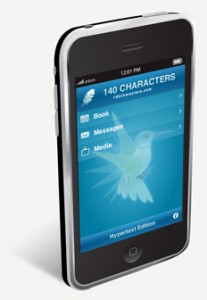 If you thought Twitter was a fad or a nuisance, let me disavow you of that notion – it is a pretty useful tool for both business and pleasure and it’s here to stay.
 The book is full of brilliant humour (or is that humor) too of how to and how not to Tweet. There are some real corkers and my Tweet stream might become a whole lot more interesting as a result of reading it.
 So just 30 days ago, I elected to start the Ultimate Blog Challenge and do a blog a day for 30 days.


 It’s simply never a better time to be an author. You can go from edited manuscript to publishing it globally as an ebook within a couple of days and in print within just a few days.
 Calling all Authors
 So you’ve written your ebook but how do you get it out to the world and even start making money from it?