by Tom Evans | Apr 11, 2011 | Scribing
 … a fresh approach to creating an eBook
Sales of ebooks are predicted to overtake paperback books by 2014. For authors especially, simply to bury your head in the sand by saying you prefer a printed book is not an option. Aside from any other consideration, increased royalties make writing with the ‘ereader’ in mind a prudent strategy.
An ebook can, of course, be an electronic copy of a pre-existing printed book. If, however, you are writing a book from scratch, there are some benefits for both you and the ‘ereader’ to adopting a slightly different approach. Note that this article mainly relates to writing of non-fiction.
The new breed of reader
The term ‘ereader’ can now refer to both the device itself and the person holding the device. Personally, I am favouring reading non-fiction on my iPad but still reading fiction in print. The reason for this is to do with reading patterns.
For me fiction is something I read curled up on the sofa at weekends or relaxing on holiday – both in long reading sessions when I can get lost in the book. Non-fiction is something I absorb perhaps a chapter at a time while commuting, in between meetings or in bed at either end of the day. I may dip back into a book for research later and often I may even read a book out of sequence; just diving into specific chapters that take my fancy.
Different devices
eBooks can, of course, be read on a desktop or laptop computer. The Amazon Kindle device with its e-ink display that can be read in bright sunlight is becoming the ‘Hoover’ of the eReader world. The fact it currently has a monochrome display should be born in mind when it comes to both cover design and embedded images.
iPads have the advantage of a larger, colour display and the ability to have audio and video embedded in the ‘book’. Don’t try and read one outside on a sunny day though.
Smartphones, typically iPhones, are also potential target devices but of course have a smaller display to consider. Making your books readable on a phone gives you access to a huge market of commuters and those with short attention spans.
For all devices, as text can be resized by the reader, the concept of page numbers flies outside the window.
A different approach
So bearing all of this in mind, content needs to be delivered in a slightly different way. Here’s my top seven tips which you will note are used in this article:
- Include a hyperlinked table of content.
- Summarise each chapter in bullets at the start or the end for the speed, skimming reader.
- Make sure you use structured headings – Heading 1, Heading 2 etc – and no fancy formatting (unless you know what you are doing).
- Restrict chapter lengths to around 1500 words – i.e. 6 or so pages in a standard book – and keep chapter lengths balanced and around the same time.
- Less is more – be brief, be concise – don’t use more words than necessary.
- Ensure images work in both monochrome and colour.
- Read your book out loud before ‘publishing’ it. If you find yourself pausing for breath, you need punctuation. Record it too and generate an audio book at the same time.
Related posts
eReading
ePublishing
In summary
Using all of these tips also works in favour of the writer. You could, for example, write a book a bit at a time as a blog or set of articles. For example, I am leaving this series open so it can morph into a book if it merits it and generates interest. This is a great way of testing the market. Book writing then becomes less of a marathon and more of an enjoyable daily routine.
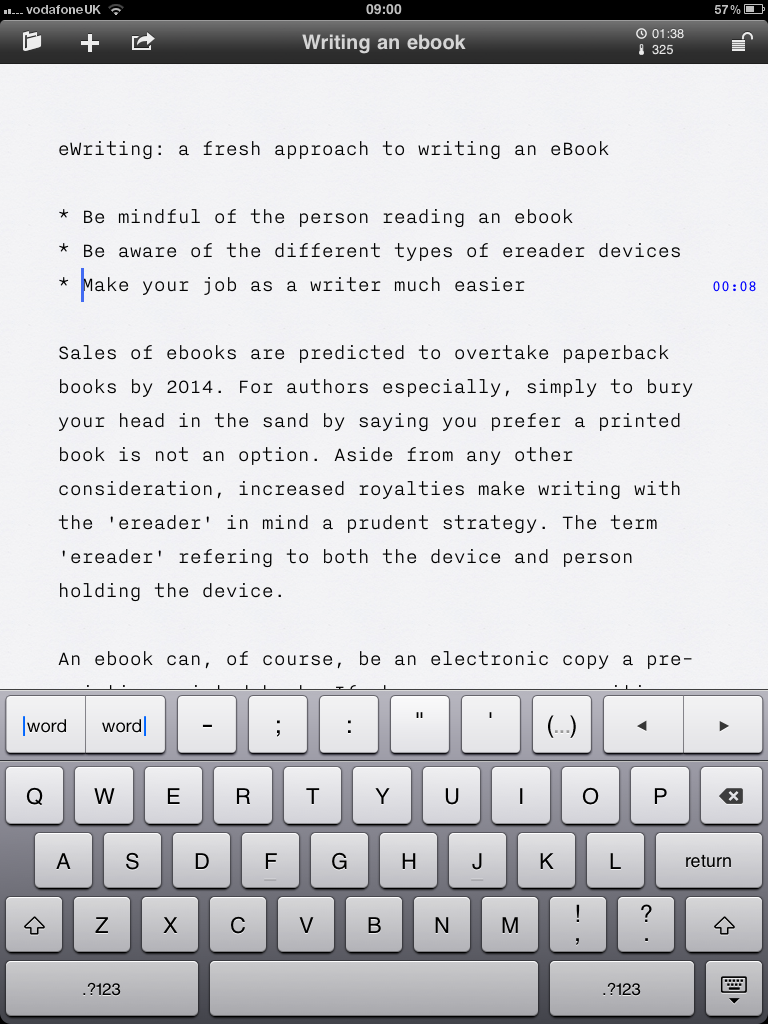
- Be mindful of the person reading an ebook
- Be aware of the different types of ereader devices
- Make your job as a writer much easier
I’ve written two books recently in small chunks, a day at a time specifically with ‘ereaders’ in mind – they are currently being merged and republished as one bigger book in print …
- Flavours of Thought: Recipes for Fresh Thinking
- The Little Book of Floughts
For more information on both, see www.flavoursofthought.com
Originally written for and posted in www.iaccw.com

by Tom Evans | Apr 10, 2011 | Scribing
 If I was writing this article just five years ago, when asked what an ebook is, I would probably have said a PDF. Where PDF is an acronym for Portable Document Format which, unlike say an Word document, is read-only and retains all the source formatting and layout.
Nowadays, with the increasing ubiquity of ereaders, it might be tempting to define an ebook as something you downloaded to be read on an Amazon Kindle or Apple iPad. To make matters slightly more confusing, the humble PDF can be read on both devices.
Where a PDF essentially differs from a book formatted for an ereader is that the latter, be it in ePub, HTML5 or the techie format, tends to be copy protected and tied to the purchaser’s account – not even their device. This means they can read it on their Kindle, iPhone and computer if they own all three.
Neither of these descriptions however fully defines what an ebook is or can be.
Before I explain, although I am a technophile and even writing this article on an iPad, as a reader, I am a big fan of the printed book. Specifically, I much prefer reading fiction in print but now favour the ‘ebook’ for non-fiction.
As an author though, I am both agnostic and catholic about how readers of my books engage with them. An ebook in my eyes (and ears) is simply any of my content which isn’t print and that is delivered by electronic means. I want the reader to choose how they engage with my work.
The publishing industry is going through the same transition as did the music industry 10 or so years ago. In some ways and in some areas, it is even overlapping and merging with it. One of the reasons being that the ebook is just about to come of age.
Now an obvious format for an ebook is audio. This allows those with visual impairments to enjoy a ‘good book’. Many people like commuters and those with dyslexic different-abilities might prefer auditory input.
The exciting developments in the ebook arena are the Enhanced Edition book and the mobile app. In addition to the rich functionality offered by these two developments, the ebook and app also come with the potential of royalties of up to 70% for the enterprising author. All of this is of course in a context where the number of target devices is in the millions and growing daily.
If I now have your attention, let me explain what they both are. Enhanced Edition books allow you to embed multimedia elements like audio and video inside a book. Good use of this format are books like Knitting for Dummies and Yoga in Bed.
For ‘ebooks’ which are apps, even richer functionality is possible. For example, user input such as completing exercises or a journal or even engaging in dialogue with the author. Content can also vary depending on date, location or user type. The latter could be dependent on parameters such as age or subscription level.
With all this choice, it would be easy to get carried away. Baby steps are advisable and market testing is essential. The future is very bright for both authors and publishers who embrace the possibilities that are opening up. The caveat being that the reader, listener and viewer is the ultimate judge of what is good use of the technology.
Related posts
eWriting
ePublishing
Some example links
Example of an ebook with embedded audio and video – Wordlube
Enhanced Edition : Yoga in Bed
A discussable book – 140 Characters the Short Form
A multimedia app : Elements a Visual Exploration
Originally written for and posted in www.iaccw.com
by Tom Evans | Apr 8, 2011 | Scribing
 So I’ve had an iPad for the best part of a year now and loads of people have asked how I use it and what I’m using it for.
Or if it’s just a bit of a toy?
Well I’ve discovered using this new type of tablet (and watch this space for the clones) ushers in a whole modus operandi.
In short, it’s brilliant – especially for writers, designers, entrepreneurs, inventors and creatives. I would struggle to go back to using a laptop.
This new way of working merits the introduction of a new word – iPadivity.
noun [n] :
1. the phenomenon of increased creativity and productivity when using an iPad – and activity while doing the same
2. the generation of new ideas using an iPad
3. profitability from generating and using iPad apps
Now I have to say everything I’ve been able to do I could do with a combination of iPhone or laptop. Some of it admittedly even with paper and pen. While the iPhone scores on portability, it lacks screen real estate and typing is slow (this whole blog incidentally was written at speed using the iPad on screen keyboard).
The laptop is just so much heavier and I have always felt a bit nerdy to get out on a commute and certainly in a coffee shop. It also takes too long to boot if you just want to do something quickly and acts as a barrier in a business meeting. The 3G enabled iPad delivers a useful synthesis of both devices which is better than both – plus I have to say it looks cool !!
This Mind Map tells the story of what I am using it for … of course generated on the iPad as were all the graphics in this blog.

The first iPadivity gain is really good use of “dead time” – those times in the day when you would have been waiting for something can now be used to process email, do a tweet or two and check out news or write a blog.
The second iPadivity benefit is being able to read, listen to or watch pretty much anything – either online, in iTunes or your own archive.
 The third iPadivity capability, and to me the most important, is being able to write stuff. Here the lightness and specific functionality of the apps comes into its own. For example, before writing each chapter of my new book, I’ve taken a hint from artist Cat Bennett and I am drawing using Brushes an image that encapsulates the concepts I am about to write about.
I am working to a master Mind Map structure for the whole book but I’ve also started mapping each chapter before eventually writing it in Pages.
This has lead me down several new avenues I simply wouldn’t have explored.
Now could I do this on the laptop or desktop – absolutely – but not when the Muse takes me – and certainly not with as much ease and FUN !!
Add to all of this, the ability to browse on a whim for research and dip into the brilliant Wikipanion app, my iPadivity is probably up 400-500% of where it was less than a year ago.
I’ve also used the iPad in several client sessions. Again, its unobtrusiveness is the key. It’s like having a paper notebook but where you can email the notes instantly. In the sessions I did last week, this included a colour-coded Mind Map of actions arising and a wireframe for an iPad app I am designing, using iMockup.

This of course points to an amazing iPadivity – the ability to encapsulate your knowledge and wisdom in an iPad app which you can share with other and generate profitability from … watch this space !!
So if you’ve got an iPad or an iPad2 or another type of tablet device, or are getting one, I’d be interested in your thoughts ….
by Tom Evans | Apr 7, 2011 | Scribing
 Writing an article on knowledge is potentially a difficult task. It makes you ask the question what do you know and even what qualifies the writer to write knowingly.
You have to ask yourself questions like who is doing the knowing and how do you know that you know? For example, you may think you know what is true and right in your head but your gut might tell you it’s wrong. Your heart might not be in it and there may a whisper of doubt sneaking into the back of your mind.
This train of thought also brings into question where the knowing sits. Is it in our cognitive centres, in the very water of our cellular structures or somewhere even more ethereal?
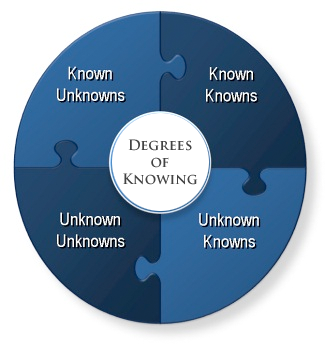
What makes the whole subject even more difficult still is that ‘we know’ there are degrees of knowingness. During the Iraqi conflict, Donald Rumsfeld, the then US Defense Secretary, was caught prevaricating as there were things he knew that he’d rather not share with others. Nonetheless, inadvertently, he gave us a really useful framework for understanding the modern world in his infamous “known knowns” speech.
There’s obviously the stuff we know we know – the Known Knowns – at least that is until we find out whatever we thought we knew, we didn’t know that well after all. I get the Word of the Day from Dictionary.com every day and keep finding words I thought I knew the meaning of actually mean something else.
There’s stuff we know we don’t know – the Known Unknowns – like where we really came from, how come we are self-aware and why toast always seems to fall butter-side down.
There’s a weird category of Unknown Knowns – these are things we know but didn’t know we knew – like someone really likes you but you are just not quite fully aware of it yet.
Finally there are the Unknown Unknowns – these manifest as the Fear of the Unknown. They are the demons that stop us in our tracks. If we don’t stick our heads above the parapet to have a look, we can’t be harmed.
If this isn’t bad enough, what you think you know can get turned on its head in an instant. The ancients knew the Earth was round but in the Dark Ages we were taught it was flat. We now know its round yet everyone uses a map which is flat.
Knowing is altered by perspective. For example, if you add another dimension to the mix, literally, what is curved space and surfaces in a 3-D universe are flat sheets in 4-D. We can see in a 2-D Flatland that the ‘flat people’ could jump up. If they did this, to another ‘Flatander’ they would disappear.
So stating we absolutely know something to be true is inadvisable. All we can ever know is that we don’t know everything. Furthermore, as soon as we know something, there is inevitably something else to learn.
Claircogniscence
Traditionally knowledge has become a left-brained activity based the output from the Scientific Method which runs like this:
- Observe something
- Make a prediction based upon what is observed
- Observe or measure something else against the new prediction
- Make it into a Law – like the Laws of Gravity or Thermodynamics
This is fine until the Laws break down.
A more intuitive basis to work on is tuning into our innate claircogniscence. This a ‘knowing’ version of clairvoyance, clairaudience or clairsentience. The source of the knowing can be from any of our chakra points – normally gut, heart, 3rd eye or crown but also the alpha and omega chakras outside our bodies.
Incidentally, don’t ask me how I know all of this. I just do and I have complete faith that what I am imparting here is knowledge that will appeal to readers of the resulting article.
Claircogniscence is more than just knowing. It’s also an inner sense that it’s OK to know in itself and there is no need to share or even prove what you know. In healing and therapy, it is the most useful tool as you can instantly get a sense of issues and how to treat them.
It’s also a vital part of the creative process. You just know what you are writing, painting or composing is just perfect. You are connected both with your Muse and your audience. You are in flow – and you Know It. It is the progenitor of the most desirable output for the search for knowledge – that of gnosis.
Gnosis
Gnosis is the result of unquestioned claircogniscence and requires no qualification – it just is. The best examples end up being koans, aphorisms or maxims.
These are stories, questions or statements the meaning of which is not best understood by the application rational thinking but may be accessible through intuition. They just feel right.
Examples range from a Zen Koan that gives us an Known Unknown by asking an incisive question like:
“What is your face before your mother and father were born?”
– to one of Hippocrates’ sublime aphorisms that, on first hearing, begets the Unknown Known:
“Life is short, and Art long; the crisis fleeting; experience perilous, and decision difficult.”
– to the pithy and witty Known Known maxims that are the stuff of urban myths such as:
“In an autocracy, one person has his way; in an aristocracy, a few people have their way; in a democracy, no one has his way.”
These kind of statements are just right; we feel it in our water. They are incontestable and don’t lend them to analysis unless you are feeling particularly fastidious.
True gnosis though more traditionally applies to a spiritual knowing.
What’s important here though is that gnosis is something which is personal. For example, it’s said that there are 33 paths of spiritual awakening. Now I don’t know if it’s true there are 33, there could be more or less. What I do know is that as soon as the path or the type of awakening is defined and proclaimed to be “The Way”, we have slipped from gnosis to dogma. All I know for sure is the path and way that I am following seems to be working for me but that I can’t wholeheartedly recommend it to anyone else.
Once you assume a dogmatic position, the acquisition of new knowledge becomes difficult and we are closed off from the next level of awakening.
I’ll leave you with one of my favourite “knowings” from the mind that was Chief Seattle –
“This we know. Man did not weave the web of life; he is merely a strand in it. Whatever he does to the web, he does to himself. Whatever befalls the earth, befalls the sons and daughters of the earth. All things are connected. This we know.”
by Tom Evans | Apr 5, 2011 | Scribing
 Rachel Willis, CEO and insightful editor of Lightworker Magazine posed a little problem for me recently to submit an article about a subject I realised I write little about.
Namely Love …
I took the decision to ‘channel’ it raw and this is what came out …
by Tom Evans | Apr 3, 2011 | Scribing
 When we click on a link, we don’t give it a second thought – especially these days when we are presented with 100’s if not 1000’s of potential hyperlinks each day.
Links nowadays are not limited to those on web sites or in email newsletters. They abound in Twitter tweets and on Facebook Walls.
Knowing how and why people click on one link as opposed to another is of course of interest to the person who posted the link. Indeed understanding how we interact with any text is important for any writer.
Here’s a typical sequence of events:
1. About a second before we are consciously aware of anything, our right brain is continually filtering information before presenting it to our left brain for further processing and analysis. This is known as whole brain filtering.
2. To get past the gatekeeper of the right brain, which works holistically, we have to write content which matches patterns the right brain will light up to. Example might include:
- Keywords – e.g. Video, ebook, iPad, your favourite football team/author/pop group
- Rhymes
- Fun & puns
- Freebies
- Double takes
- e.g. If I had written Triple Take, the right brain would inform the left that there is something new it doesn’t understand that needs analysis
3. Once the left brain is presented the information, it analyses it further with criteria like – is it a con or a spam and is it something to deal with now or park for later? If the former, the motor commands to our arm and hand muscles to click on the link are issued.
4. When we then look at the destination page the whole process is repeated for the opening paragraph – or the image or first few seconds of the audio or video – and then so on for all subsequent content until we meet another link that we follow.
5. So our right brain analyses the whole and our left, the detail.
As for the Google search engine, both have to match otherwise our spam filter kicks in. For example, if we thought we were on a page containing a freebie but it becomes clear the point of the page is to sell you something, you will soon go elsewhere. Long sales pages try and subvert this process by beating the left brain into submission.
“OK,” it says, “I didn’t want to buy anything but it was $5000 and I can get it for only $20 today only.
“The overruled right brain screaming, “They saw you coming.”
6. For best results, the message needs to be completely congruent say from from initial Tweet, to blog title right through the body text to the final call to action.
7. If you have read this far, you will be approaching the call to action – yes, this blog is a soft selling page. Do you feel conned? I hope not as this blog contains some useful free information.
by Tom Evans | Apr 2, 2011 | Scribing
 I am thrilled and extremely honoured to be able to contribute to the 1st issue of Inspire – a new free magazine from of the amazing WeCollaborate community.
My belief is that there is only a recession if you want there to be one – by bringing inspiration to the workplace, you literally breathe new life into it.
… you can read my article and other erudite thoughts from some amazing writers in the mag here.
by Tom Evans | Mar 29, 2011 | Scribing
 I am often asked by both new and experienced authors how you go about protecting your books in the digital age.
In these days when you can blog a story or submit an ebook direct to the Amazon Kindle Store, the Apple iBookstore or to one of many aggregator sites like Issuu, Lulu, BookBuzzr and Smashwords, what’s to stop anyone stealing and copying your work illegally?
If you submit your novel to a author community site like Authonomy, what’s to stop someone stealing your idea and writing their own book on the subject?
Well if you think about it … not a lot and it’s not much different from how it has been since Caxton invented the printing press.
If you produce a printed book, there is nothing to stop anyone photocopying it. How many times have you borrowed a book and read it and not paid the author or the publisher a penny? How many times did you not give it back?
For digital products, you can add password and enable DRM protection but there is nothing to stop someone telling someone else the password. Even if the digital rights management is tied down to a particular device as it is for Kindles, iPhones and iPads, there is nothing to stop people other than the purchaser enjoying the work.
I am sure when you write your book, you didn’t do it in isolation of any influences from other authors, friends, colleagues or teachers.
By far the best way by far to protect your work is to look at your behaviour and modify it so it’s karmically balanced.
Now I am not trying to preach here or be holier than thou – this is just good common sense and politeness and I too have fallen foul of not playing by the karmic rule book.
My seven top tips for karmic rights protection
1. Don’t run the fear your work will be copied
2. If you use a quote or concept from another writer, give them some credit in a Thanks section of your work or, at least, list their book in references
3. Be open to your payback coming back in another form other than the sale of your books
4. Don’t steal another writer’s work
5. If you like a book you borrowed, buy a copy or buy another book from the same writer
6. Give loads of stuff away for free
7. Be thankful for everything you receive
_________________________________________________
– just think what it would be like to live & breathe in a world that worked to these principles, it’s within our grasp & starts with each one of us today
p.s. if you ‘breach’ the spirit of KRM, you will find others will ‘steal’ from you
by Tom Evans | Mar 28, 2011 | Scribing
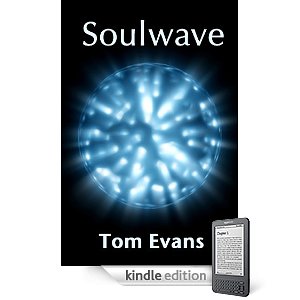
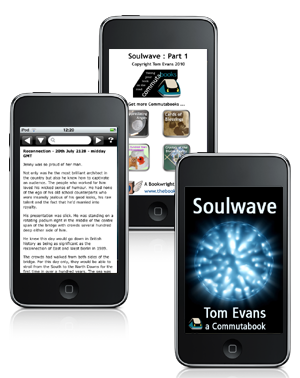 Soulwave is a short story extracted from my forthcoming novel.
At only 7000 words long, you can read the whole book in a single commute on your iPhone or Kindle.
Soulwave is a future-history – that is something that might just happen It has happened to the Earth in the past and will undoubtedly happen again – we just can’t say when. It makes any fears about global warming seem trivial.
Although the message seems terminal, the story is really about how life propagates around the Universe that we are just one small part of. It will make you realise that we are only alive on this planet at this time by the slimmest of coincidences. Our planet and solar system are very special and we should cherish them and look after them.
Soulwave is completely free for the iPhone so why not download it today and I’d be so grateful for your feedback here and in the iTunes store.

Note that it’s also available for the Amazon Kindle and Kindle readers for PC, Mac, Blackberry, Android etc but Amazon don’t seem to be allowing UK authors to add free stuff yet so I’ve made it as cheap as they let me.